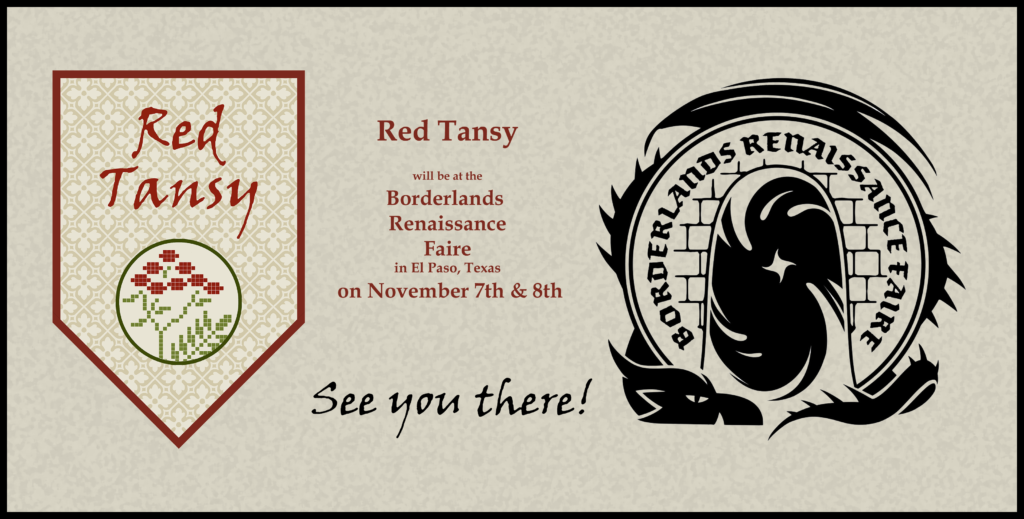
I’ll be at Borderlands Renaissance Faire in November

Borderlands Renaissance Faire is a new-in-2026 renfaire in El Paso, Texas. I’m very much looking forward to this one, in part because the people organizing this faire seem, well, organized, and that’s reassuring to me as a vendor. And isn’t that a great logo?

New Designs: SCA Kingdom-Level Orders

This is a slow time of year for new SCAdian populace badges (all the heralds are busy with Pennsic stuff), and I’d run out of stuff to work with, so… I decided to make some fabric designs with kingdom-level Order badges: just allover patterns and banding for these (although, as always, custom orders are welcome, and wouldn’t a mug rug with an Order’s badge make a nice gift for a new member of that Order?), available in any fabric that Spoonflower sells. (The above picture shows banding for Ansteorra’s Order of the Iris and the allover pattern for Atlantia’s Order of the Sea Stag.)

In my Zazzle shop, I now have buttons and patches with the badges for every kingdom-level Order I could find information on. (Picture shows a button for Atenveldt’s Order of the Hope of the Sun and a patch for the Order of the Gryphon’s Pride of Artemisia.)

SCAdians, are you ready for Pennsic War 53?

I have new designs in my Spoonflower shop, including a lot more featuring SCA populace badges. Make a banner/gonfalon to decorate your encampment, or sew some lightweight linen/cotton fabric into hot-weather-friendly garb printed in a Renaissance damask pattern… Plus, I do custom designs, and there’s still time to get something printed with your personal heraldry.

(The pic above shows examples of my fabric designs: allover-pattern reproductions of medieval and Renaissance fabrics, plus an allover pattern, two different sizes of DIY banners, and banding/trim all featuring SCAdian branch populace badges.)

It’s not ALL Renaissance and Medieval…

Most of my fabric (and other) designs are based on textiles or art from the Middle Ages or Renaissance, but sometimes I do reproductions of stuff from the 1800s. Like this:

I just made this design this morning.

A customer contacted me by email, asking if I could make a reproduction of the fabric from a dress on display in the museum where she works. She sent me two high-resolution photographs so I could really see the pattern and get an accurate idea of both scale and colors. A few hours later… ta-da!

I’ve been busy the past few weeks with making wall hangings to sell in my renfaire shop. In addition to favorites from last year (I’m making twice as many “Weird Hobbies” this time, so maybe I won’t run out on the first day again), I have eight new designs. And a half-scale version of the Lady and the Unicorn “tapestry” hanging on the back wall of my shop.

I plan to be back at the Hub City Renaissance Faire this autumn.

Images from my Renaissance Faire Shop, 2025

My shop sign:

Having a thematically appropriate shop sign (it’s a Renaissance faire: no vinyl signs, please!) is a big plus when it comes to making a good impression and attracting customers. And lots of attention from local news people reporting on the faire: I don’t know if it’s entirely because of the “historical-ness” of the sign, or partly because the sign hangs perpendicular to the row of shops and therefor is just easier to see, but this sign always gets into video/photos from a faire. I could have gone with a painted wooden sign, but since everything I sell is made of fabric, a fabric sign just seems right.

Shop interior, right-hand side:

As you can see, I’ve changed things a bit from my 2024 setup: There are fewer mug rugs out at one time (the extras are in a box under the table, hidden by the fitted tablecloth — the red table runner hides a split in the tablecloth for access to the space underneath), and the rolled wall hangings are standing upright in their crate to make them easier to search through. There are also more wall hangings on display, because I have more designs. (I’m running out of wall space under this 10×10 canopy! I may have to seriously consider getting something bigger.)

The red string on the first three wall hangings is to keep them from flipping over every time a breeze gets into the shop. (I’m still looking for a good solution to this.)

Shop interior, back wall:

Another thing that gets a lot of attention for my shop is that “tapestry” on the back wall. (Plus, there’s often a big man in armor sitting in the wooden chair in front of it. He attracts a lot of attention for the shop, too.) The 4×6-foot tapestry is printed on heavy basket-weave canvas (because at this scale, the fabric needs to have some texture) and backed with cotton osnaburg. I’ll have smaller versions in my shop next year, and at least a few of the full-sized ones.

I had to put some of the wall hangings in front of the tapestry, because there wasn’t room anywhere else. (That’s another thing I’m working on; I’m already working on a new shop layout for 2026 that will give me more wall space to hang stuff.)

Shop interior, left-hand side:

Here’s the shelf with all the throw pillows. (The ones in the top row are velvet and feature images from the famous The Lady and the Unicorn tapestries. The rest are cotton twill, and most have artwork from the Luttrell Psalter.)

The table toward the back holds a display tray with bookmarks (new in 2025), as well as the mini-crate that holds my business cards, and a bigger crate for paper bags to make the whole check-out process easier. (My card reader is tucked away behind the sign on the table.)

Requesting a custom textile design from Red Tansy

The tl;dr version: The more information you give me about what you want, the less time it takes me to create it. The less time I need to work on creating a design, the less likely I’ll need to charge a fee for that time.

I generally don’t charge for the time it takes to create a design, unless it’s a very complicated design or a lot of revisions are necessary. In order to avoid the latter, the customer should 1) know what they actually want, and 2) let me know what they actually want.

A vague description such as, ‘I want an old-style floral pattern, and I want it to be kinda small, in yellow and lavender’ is better than no information at all, but I need to know what yellow and lavender, and I need to know what ‘kinda small’ means in this context. Also, all my floral patterns are “old-style,” since I specialize in reproductions of medieval/Renaissance designs. What era are we talking, here, and what culture? Byzantine? Fifteenth-century Spanish? (‘Kinda small’ for a Renaissance damask could be a 12-inch horizontal repeat, if the original textile was twice that size.)

Also concerning color… I cannot work from Pantone colors; please do not send me a Pantone code and ask me to duplicate that color. I can work from a hex code (example: #8e0800, which is a lovely red), and if you have the hex codes for the colors you want, that really simplifies things.

If the customer doesn’t need an exact match – if all they need is ‘red and yellow/gold that look good together and aren’t too saturated’ – I can work from that, too. If they want, ‘THIS design [includes name of design and/or link to it in my online shop], but half-sized and in the blue from your “Renaissance Damask with Cats – Prussian Blue” because that’s my cat’s favorite color,’ the whole process of creating a design to those specifications would take less than an hour, and probably not require any revisions after I send the initial test image to the customer for approval.

(If the customer does need an exact match, they’ll need to purchase a test swatch of the design printed on the fabric of their choice. You cannot go by what the colors look like on your computer screen. Even many greys print lighter or darker than they appear onscreen.)

Unless I am specifically asked to do otherwise, all custom heraldic designs will be made using same colors I use for my other heraldic designs. (See any of my SCA/”Creatively Anachronistic” collections for examples.) This is because these colors look good together, have good contrast (the whole point of having rules about what colors can go next to each other in heraldry), and are strong without looking harsh. (I’ve noticed that many designers who do SCAdian stuff seem to use the same hex codes as are used for electronic submissions of heraldic devices… Thus, the yellow is intensely lemony instead of golden, the green is eye-searingly bright, the purple is too blue, and the blue is too dark.)

So that’s color. Another consideration is size/proportion.

Say a customer wants an allover heraldic ermine pattern. The color isn’t in question; ermine is black on white. But what size for those ermine spots? How far apart, or does that matter? (Also, should they be fairly simple, or should they be those extra-fancy ones with the spikey ends?)

There’s no way to cover every possible eventuality here, but you get the idea: the more information I have upfront, the more smoothly the design creation process works for both me and the customer.

Huzzah! It’s Renaissance Faire Time!

Tomorrow, I’ll set up my shop for the Cottonwood Renaissance Faire (because setting up the day before is soooo much easier than rushing to get everything ready in a mere two hours). The faire runs for two days: this Saturday and Sunday, from 10 AM to… around 6:30-ish.

Then, next weekend, I’m off to Lubbock for the Hub City Renaissance Faire, a one-day event. I had a wonderful time last year and am very much looking forward to it this year.

Photos of my shop from the 2024 Hub City Renaissance Faire.: